

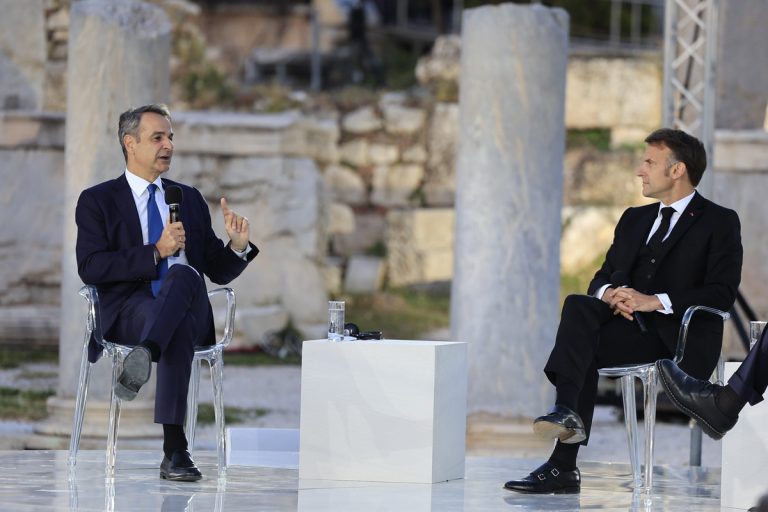
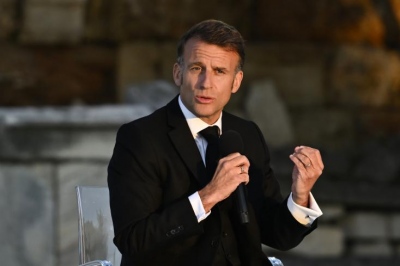
The French newspaper Le Parisien Matin in a report a few days ago revealed that Emmanuel Macron is negotiating in Greece the transfer of Greek Mirage to Ukraine, causing an uproar and strong reactions in military and political circles in Athens.
As those who advocate fierce resistance to French pressure point out:
1) A huge financial obligation will be created which Greece will not be able to meet given the enormous size of its defense program and the country’s dire fiscal position.
For this the “cheese” is that the difference will be paid with part of the 90 billion euro loan to Ukraine, but these will likely be crumbs to restore the operational capability of the air force.
2) A huge gap will be created in the country’s defensive shielding, which until now had air superiority over Turkey.
3) It involves our country in the front in Ukraine, integrating it into the anti-Russia coalition of the willing and creating a huge risk with our inclusion in the famous missile defense umbrella.
What the plan includes
This plan concerns approximately forty aircraft, which will be exchanged for Rafale. This massive air reinforcement for Kyiv will depend on the financial terms of Dassault and production timelines.
The Greek government has denied this scenario, as the government spokesperson Pavlos Marinakis, during the briefing of political editors, was asked about the report of Le Parisien and replied that no such thing applies.
“It does not apply, nor could such a thing happen, because the Mirage are purely operational. Therefore there is no basis for this information,” stated Mr Marinakis.
These negotiations, which were revealed about ten days ago in the Greek press, specifically by the newspaper Estia, were also confirmed by the newspaper Les Echos from multiple sources.
Discussions between the Greek side and the French are recorded as intense if not tense.
This complex issue appears to have caused dissatisfaction on the Greek side, due to French pressure considered excessive.
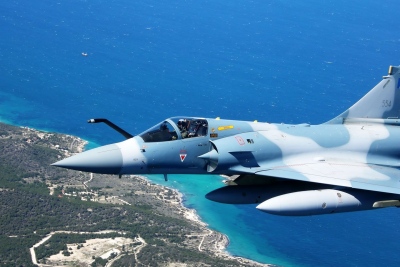
Athens, which currently has 24 Mirage 2000-5 (as well as 10 Mirage 2000 EGM/BGM in storage), appears reluctant to immediately sell half of its fleet, although the aircraft are aging and the maintenance contract with Dassault expires in 2027.
Already since 2024, Kyriakos Mitsotakis had ruled out such a possibility, stating that the Greeks “will not do anything that could downgrade the country’s defense capabilities”.
The Mirage, together with the American F-16 and especially with a fully operational squadron of 24 Rafale (12 used and 12 new), form a Greek air force that surpasses the Turkish one.
Violations of Greek airspace have been drastically reduced, as Athens has a strategic advantage over the neighbor.
“The replacement of the Mirage with the acquisition of Rafale was planned, but on a long-term horizon, until 2030, and was not on the immediate agenda. The Greeks were taken by surprise, both because they fear that a strategic gap will be created between the sale of the Mirage and the delivery of the Rafale, and for reasons of financing and overall cost,” explains to the French newspaper Sophia Clément Mavroudis, senior defense researcher at ELIAMEP.
The economic issue
The financial package of the agreement indeed remains open.
The price of a used Mirage cannot be compared with that of a new Rafale and, given that France, which faces fiscal difficulties, cannot allocate more Mirage to Ukraine, Greece does not have greater financial flexibility.
Athens last year launched an extensive investment program of 25 billion euros for the modernization of the armed forces until 2036, but about 12 billion have already been committed.
At the same time, Greece has expressed interest in acquiring approximately 20 F-35 from the United States.
The 90 billion loan to Ukraine
Only a package with European funding could make the agreement feasible.
Through a 90 billion euro loan, Ukraine could purchase the Greek Mirage, thus financing also the down payment for the order of new Rafale by Greece. In case of an agreement, which has not yet been reached, Dassault will be called to make a significant financial concession in the final price.
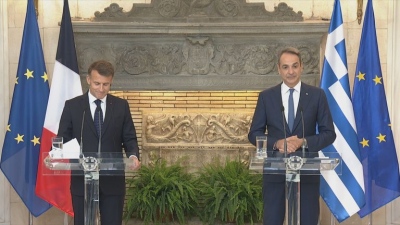
Negotiations are expected to continue during the visit of Emmanuel Macron.
Sources close to the Élysée reported that “defense contracts” will be signed, although these may concern other agreements, such as the sale of Blacksword Barracuda submarines of Naval Group or Philoctetes armored vehicles of KNDS to Greece.

An example of cooperation
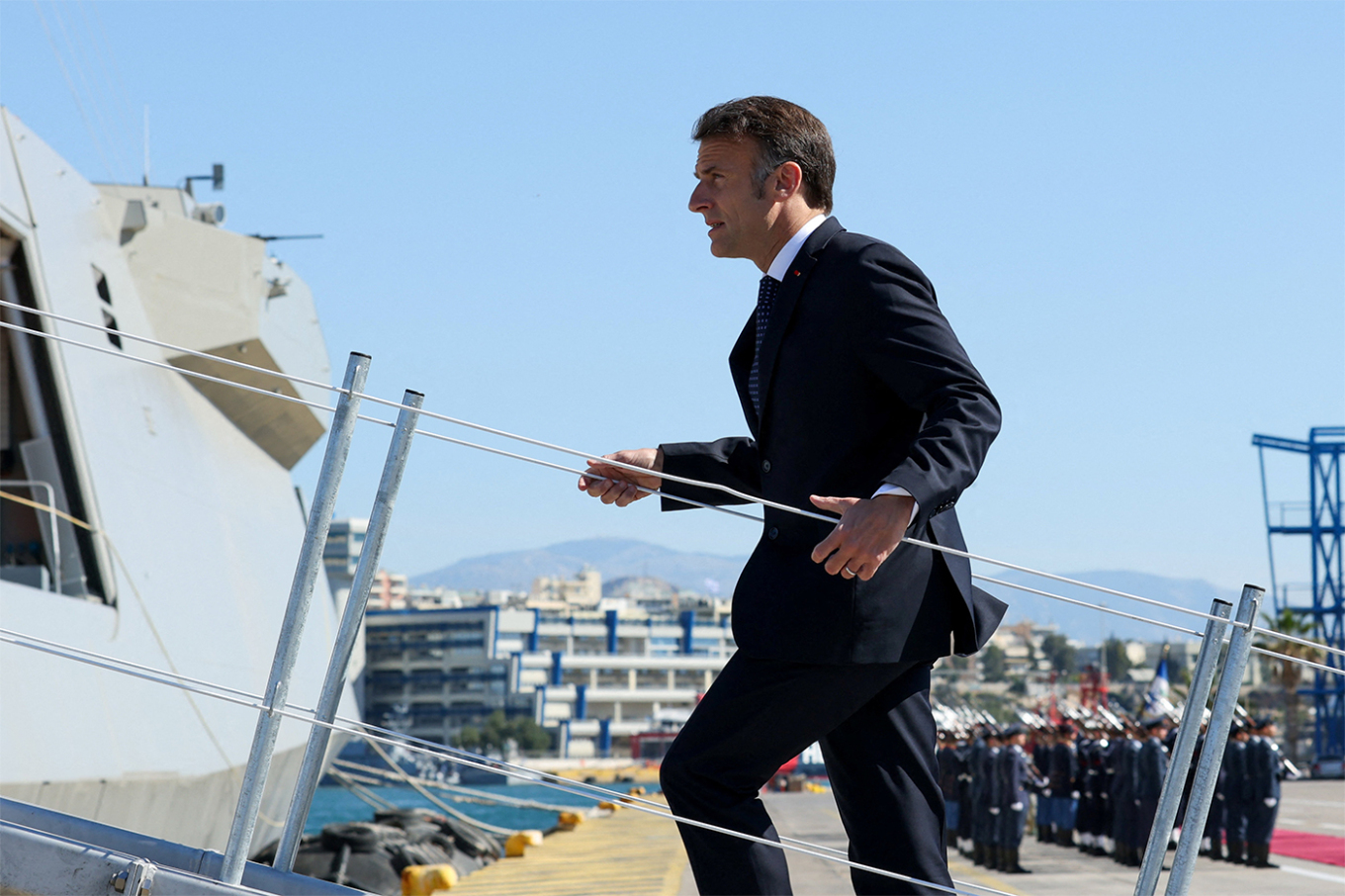
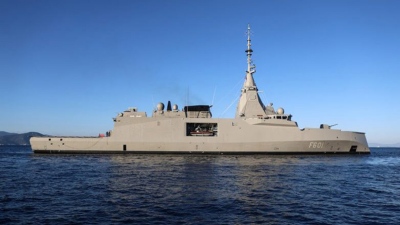
The Franco-Greek strategic cooperation, signed in 2021, will be renewed “not for five years, but with a regime of tacit renewal”, during the visit of the frigate Kimon, the first of four delivered by Naval Group to Greece.
Although the bilateral relationship works “extremely well”, as noted by a French diplomat, the clause of mutual assistance will be reaffirmed, but will not be extended to issues of territorial integrity, as the Greek side wished.
Nuclear deterrence and Russian warnings
The Dassault Rafale is officially a multirole fighter.
In practice, it constitutes today the core of French airborne nuclear deterrence. Equipped with the supersonic ASMP-A missile, with a range of approximately 500 kilometers, it can strike strategic targets with a high-yield nuclear warhead before the opponent even perceives it.
In the Rafale B and Rafale M versions it is the main carrier of French nuclear deterrence, designed for deep penetration missions in a high-threat environment.
Its operational philosophy is based on high operational capabilities, precision and strike speed, with the spearhead being the supersonic ASMP-A missile, launched from a safe distance.
The Rafale can perform nuclear missions beyond 1,800 kilometers without refueling, while with aerial refueling it gains almost unlimited range.
It flies at very low altitude to avoid detection, while the SPECTRA system functions as a “digital shield”, detecting and jamming threats, creating false targets and guiding the pilot.
The AESA radar and IRST allow detection of targets with or without emission, enhancing mission secrecy.
The ASMP-A, with speed above Mach 3 and adjustable nuclear yield, is launched outside the defense zone.
In a network-centric warfare environment, the Rafale connects with other means, while the two-seat crew manages flight and mission. It thus offers speed of response and flexibility that explain its strategic importance.
This choice is not random. France has for years rejected the model of heavy strategic bombers such as B-2 or Tu-160.
Instead, it invested in speed, flexibility and surprise.
A Rafale takes off, strikes and returns without the need to declare a general alert.

The “umbrella” that worries Moscow and puts it in the frame
This strategy takes on new dimensions amid Russia’s aggression in Ukraine.
Paris is considering the possibility of extending its nuclear deterrence to other European countries, an “umbrella” that could complement or even partially replace the American presence on the continent.
To make this a reality, French Rafale would need access to bases outside France.
And here things begin to become politically charged.
Greece entered the “frame”, Greece appears in Russian warnings for a very specific reason, it already has Rafale in its arsenal, therefore it also has the infrastructure to support such operations. This does not mean that Athens plans to host nuclear weapons, such a thing would require a series of political decisions which the political system cannot withstand.
It explains however why the country is on the list of “targets” of Russian diplomatic pressure.
The backbone of the Franco-Greek agreement
The plan according to Le Parisien Matin is based on a complex industrial and military structure.
France proposes to repurchase from Greece the entire fleet of Mirage 2000, in order to redirect it to the Eastern European front. In exchange for this transfer of Greek Mirage to Ukraine, Athens will benefit from preferential terms for the acquisition of next-generation Dassault Rafale fighters.
This exchange will allow Greece to modernize its arsenal within the framework of the defense plan “Agenda 2030”, while it will be freed from aircraft with increasingly high maintenance costs.
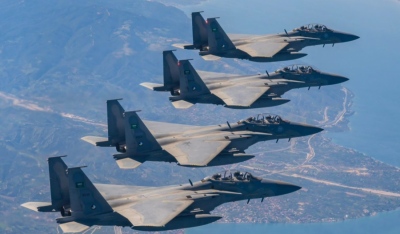
The fleet concerned by the plan includes 24 aircraft of type Mirage 2000-5 Mk II, known for their interception capabilities. In addition, there are 17 to 19 older EGM/BGM models, which could be used as a critical source of spare parts.
The success of the transfer will depend on the speed at which Dassault will be able to deliver the Rafale, at a time when its order books are already full with major international contracts.
Issue of sovereignty in the Mediterranean
Although the technical aspect appears to have progressed, the political dimension remains sensitive.
Greece must ensure that this massive withdrawal of aircraft will not create a security gap against its regional neighbors. The Greek government is carefully weighing the data, as the protection of the Aegean remains a top priority.
However, the impending expiration of technical support of Dassault for the Mirage 2000-5 in 2027 makes, according to the French, the transfer a particularly realistic option for Athens.
The French Ministry of Defense emphasizes that the operation is part of a logic of pooling European resources.
Through the centralization of the management of Mirage fleets, Paris seeks to create a cohesive “fighter alliance”.
The transfer is considered a key pillar of a strategy of standardization of the equipment used by Ukrainian pilots, who have already been trained on French systems.
Strengthening the Ukrainian air force
On the field, the arrival of forty fighters could radically change the dynamics of operations. These aircraft can use Scalp missiles and carry out advanced aerial surveillance missions.
According to a military advisor of the Élysée Palace:
“This plan constitutes the most significant contribution to the air superiority of Kyiv since the beginning of the war.”
Operational integration remains a challenge, but France has committed to providing full technical support on Ukrainian territory.
Despite obstacles in the production of the Rafale, Paris is betting on gradual deliveries in order to satisfy Greece.
The goal is to complete the transfer before the end of the summer, allowing rapid operational utilization. This move confirms the leading role of France in the technological support of the Ukrainian air force.
Diplomatic fever in Athens and what Kyiv expects
The coming weeks will be decisive for determining the financial terms.
Macron is expected to officially approve the agreement during his meeting with the Greek Prime Minister.
The transfer of Greek Mirage to Ukraine is not simply a sale of weapons, but an act of European solidarity that reshapes the military balance. Athens is asking for guarantees for immediate compensation, in order to avoid any reduction in operational capabilities.
France may also include packages of advanced air-to-air missiles, in order to ensure the immediate effectiveness of the reinforcement.
Kyiv is now awaiting the final “green light” from the Greek authorities.
This issue will remain at the center of European military developments until its completion at the end of April.
The transfer of the Mirage thus emerges as a founding act of a new era for the air force in Europe.
A new approach to French influence
This move reflects the transformation of French industrial diplomacy, which is no longer limited to simple sales, but organizes a strategic “recycling” at a European level. Through this exchange, Paris places the ecosystem of Dassault at the core of European defense, bypassing the production problems of the Rafale.
For Europe, this precedent softens the taboo of mass transfers of heavy weapon systems and introduces a new model, the circular economy of armaments.
In the long term, this “forced solidarity” may form the basis for a common military autonomy, where the technological obsolescence of one ally is transformed into an operational opportunity for another, developments that overturn the country’s diplomatic balances.
www.bankingnews.gr

Σχόλια αναγνωστών